
Notepad.LM Review: Why This AI Writing Tool is Essential
November 18, 2025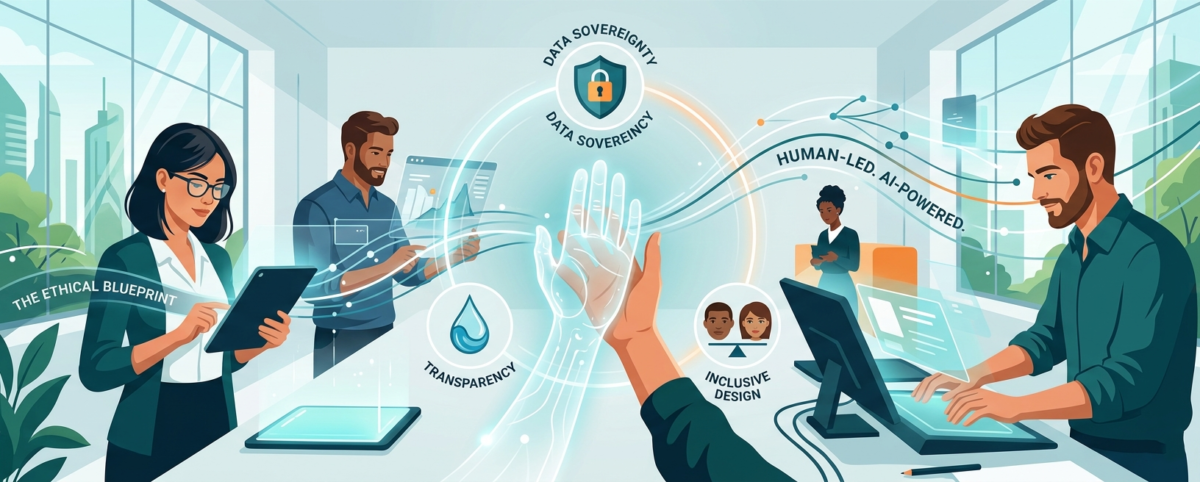
Beyond the Prompt: Navigating the Ethical AI Workflow
For years, the design industry viewed AI with a mix of awe and anxiety. By 2026, that tension has evolved into a sophisticated partnership. Agencies are no longer just “using” AI; they are orchestrating it within rigorous ethical frameworks that protect both creator and client.
1. From Creator to Curator
The most significant shift in agency workflow is the transition of the designer from a solo executor to a high-level curator. AI handles the “drudgery”—resizing assets, generating initial mood boards, and running accessibility audits (like color contrast and screen-reader compatibility)—in seconds.
However, the ethical anchor remains the human. Agencies now employ “AI Art Directors” who vet every output for:
- Brand Integrity: Ensuring AI-generated variants don’t dilute the core identity.
- Emotional Nuance: Validating that the work resonates with human empathy, something algorithms still struggle to replicate.
2. Data Sovereignty and “The Shield”
In 2026, “Shadow AI”—the unauthorized use of consumer-grade tools—is a major liability. Ethical agencies now utilize “Private LLMs” or enterprise gateways. This ensures that proprietary client data and trade secrets are never used to train public models.
By building a “security-by-design” architecture, agencies can offer clients Data Sovereignty, ensuring that every pixel generated stays within the legal and ethical boundaries of the project.
3. Radical Transparency and the EU AI Act
With the full enforcement of the EU AI Act in 2026, transparency is no longer optional. Ethical workflows now include:
- Watermarking and Metadata: Clearly labeling AI-assisted content to maintain trust.
- Provenance Logs: Maintaining an “audit trail” of how a design was conceived, from the initial human prompt to the final refined output.
- Bias Audits: Proactively testing generative outputs to ensure they don’t reinforce harmful stereotypes in visual storytelling.
4. Inclusive Design by Default
AI is uniquely positioned to make design more inclusive. Agencies are using AI-driven agents to simulate various user needs—predicting friction points for users with visual impairments or neurodivergence before a single line of code is written. This “Shift Left” approach means accessibility is baked into the workflow, not tacked on at the end.
“The goal isn’t just faster design; it’s smarter, fairer design. AI provides the speed, but human ethics provide the direction.”
Looking Ahead
The agencies thriving in 2026 are those that treat AI as a teammate, not a replacement. By focusing on accountability, transparency, and human-centric craft, they are proving that technology can amplify the soul of design without losing its heartbeat.